
Young Brazilians no longer watch TV, and GloboPop may seem like a desperate attempt by the broadcaster to compete for the attention of this audience, which focuses on social media.
But this is a superficial reading.
With a market view, what we see is a Brazilian power making a big bet, at the forefront of a dispute against multinational giants.
A battle to try to keep the attention, data, culture and money of the Brazilian public within Brazil.
What is GloboPop
Globopop is Globo's new short video app, with feed consumption, which brings together vertical soap operas, content produced by the Globo cast, materials from invited partners, and videos from news portals such as G1 and Gshow.
We can call it "Globo's TikTok", but with an important difference: unlike traditional social networks, GloboPop focuses on producing and broadcasting authorial content. So far it does not allow users to create and publish their own content.
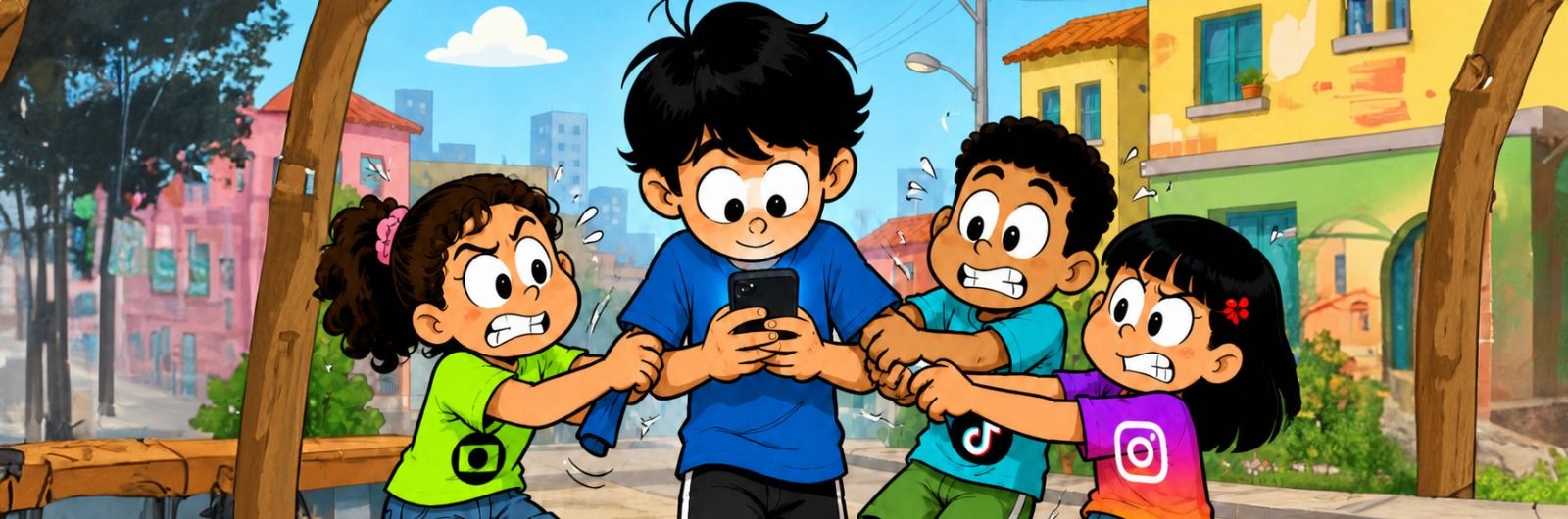
Why did Globo create GloboPop?
With attention increasingly divided between TV and the feed, an important movement is beginning to connect traditional media and digital media. This is not a battle between TV and the Internet, but rather a bridge where the two forms of communication complement each other.
Depending on digital platforms as a source of income and distribution brings numerous insecurities. Lack of control over what is delivered, high competition for attention, and dilution of profits.
Platforms like Instagram and TikTok deliver visibility and connection with the public, but it is necessary to be aware of the particular interests of these companies and the power they exercise through algorithms: control of what is seen, by whom it is seen and when it is seen.
GloboPop is a response to the current scenario of the Creator Economy and the digital universe of entertainment and information.
What does Globo have to gain
We are talking about a Brazilian giant, used to having total control over the narrative and the means of distribution. With history, credibility, resources and power to influence, inform and entertain a nation like Brazil.
Globo does not want and should not be at the mercy of algorithms and multinational companies that change the rules all the time and decide their reach.
Furthermore, there is the issue of monetization through ads and advertising content. Traditionally, this is one of the broadcaster's biggest sources of income, but in the current scenario this money ends up being diluted among other platforms.
GloboPop has the potential to regain part of this control and monetization.
And you can go even deeper.
With its own app, Globo not only controls programming, but also has full access to audience visibility, behavior and engagement data.
This data is important because, through it, we find patterns of behavior and consumption that are capable of guiding advertising strategies, editorial decisions and even finding ways to influence culture.
What GloboPop delivers to the user
In short: Brazilianity and culture.Entertainment made by Brazilians and for Brazilians.
The chance to move and strengthen the entertainment and technology economy in Brazil.
And the opportunity to not depend exclusively on international platforms to consume, distribute and value our own culture.
Globo is a great cultural power in Brazil and Brazilians are a great power of engagement on social networks. Investing in new technologies that serve this audience and the Brazilian economy is a smart choice.
Let's go to the numbers?
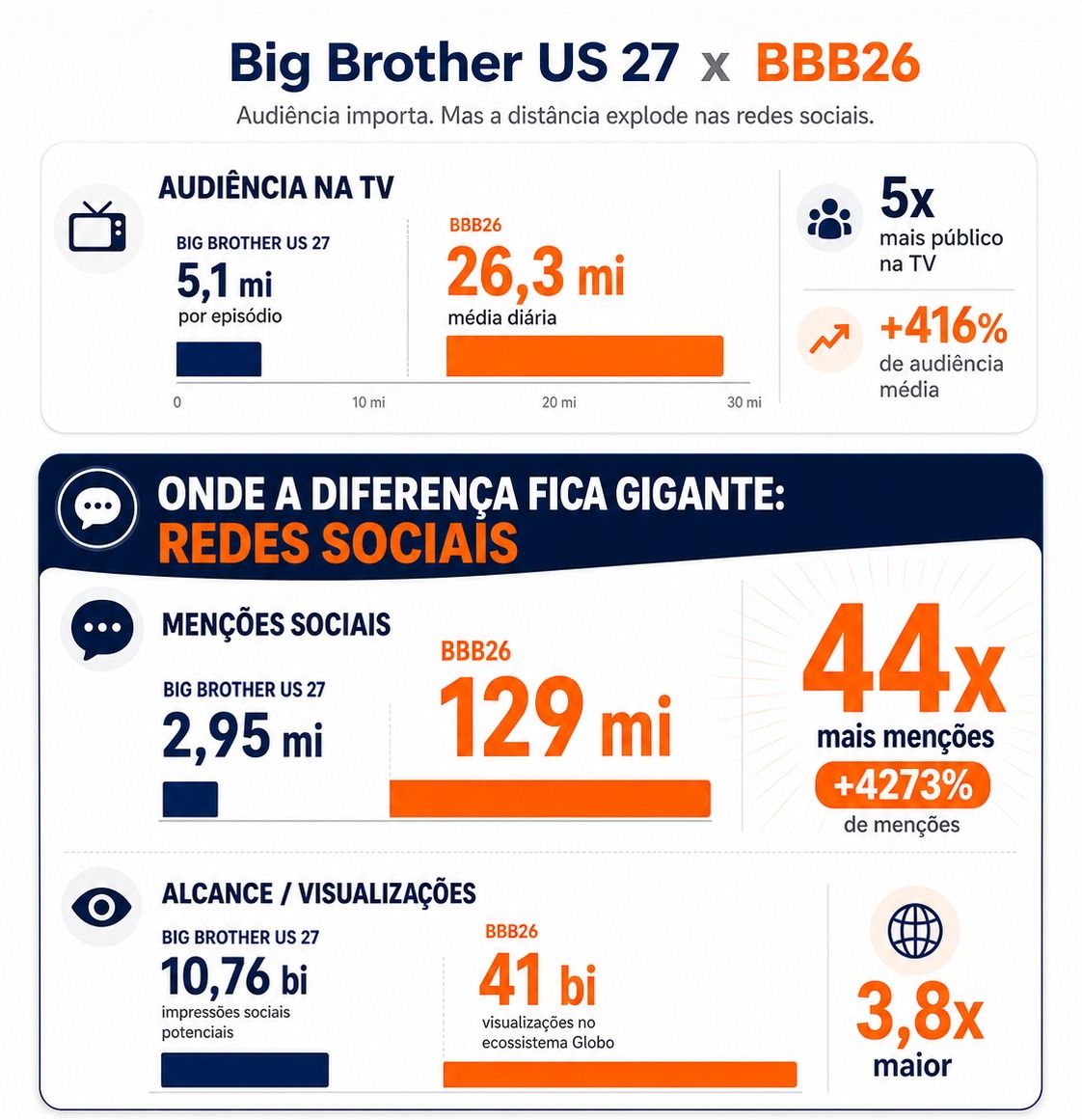
Big Brother US 27 had a relevant audience for American TV standards: 5.1 million viewers per episode. On social media, the show accumulated 10.76 billion potential social impressions and 2.95 million mentions.
BBB26 had a very strong audience by current Brazilian TV standards, with a daily average of 26.3 million people. On social networks, it surpassed 41 billion views in the Globo ecosystem alone and generated more than 129 million spontaneous mentions.
This means that BBB26 had 5 times more audience than its American version on TV (416% more average audience), but generated almost 44 times more conversations on social media (4273% more mentions).
In other words, the difference in audience was already large, but the difference in social movement was much greater.
All this movement on social media boosts the program and the Globo network, but leaves a lot of money on the table for the platforms where these mentions occur.
What Globo tries to do with GloboPop is to bring these conversions and the "internet gold" (public attention) to itself.
It is, yes, about profit and business strategy, but beyond that, it is about taking possession of a space that can and should be ours.
Brazil has immense creative and cultural potential.
I speak as a woman who lived and worked in media in the US, the UK and Brazil: we still don't know how to value the creative powerhouse that we are.
It is necessary to support, encourage and participate in initiatives that benefit the public, creators and Brazilian companies.
That's why I see GloboPop as a great opportunity.
But will it be used correctly?
Where GloboPop can go wrong
Here’s my humble list of recommendations:- The application needs to serve, first and foremost, the public and not the interests of the Globo network. It seems obvious, but many companies make mistakes on this point. Putting the public's experience above commercial interests, in this first moment, is the only real chance of prosperity, amidst competition.
- The content delivery algorithm needs to be in constant development and optimization. It will take time to mature the best way to deliver content to each user. Investment in technology and data analysis professionals who inform this algorithm is essential.
- Strategies that reinforce repetition. People are already used to and familiar with other platforms. Creating incentives for the public to access the app daily will make all the difference. I believe that, initially, these strategies should be combined with other platforms, instead of trying to compete head-on.
- There is a lack of co-creation and audience presence. In my view, GloboPop's biggest mistake so far is not allowing users to participate in the production of content. People want to be seen and heard, and the app needs tools to make that happen. The public wants to comment and respond with videos. Want to recreate iconic moments and memes. They want spaces and communities within the app, where they feel like they belong.
If it is well executed and knows how to prioritize the public, GloboPop could become one of Globo's most important digital initiatives. Bringing audience, data and revenue back into your own ecosystem.
Furthermore, it could represent an advance for Brazil in software and entertainment. Generating jobs, culture and greater turnover of advertising resources on a national scale.
If not, you run the risk of being just another app competing for attention in the feed.
And it leaves the door open for other technologies to take this space and revolutionize the Brazilian Creator Economy before Brazil realizes the size of the opportunity it had in its hands.